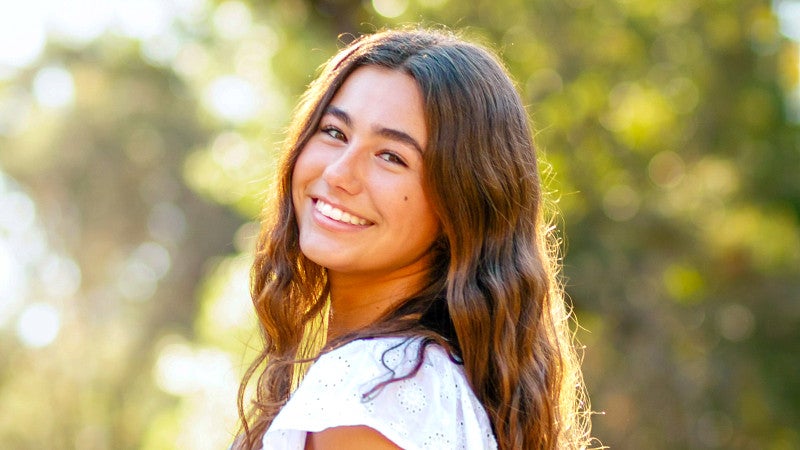
Jenae Sperling’s media studies capstone examines whether increased visibility has led to equity for women athletes.
Women’s sports have gained more attention and visibility in recent years, but Jenae Sperling ’26 wanted to know whether that increased exposure actually meant meaningful progress.
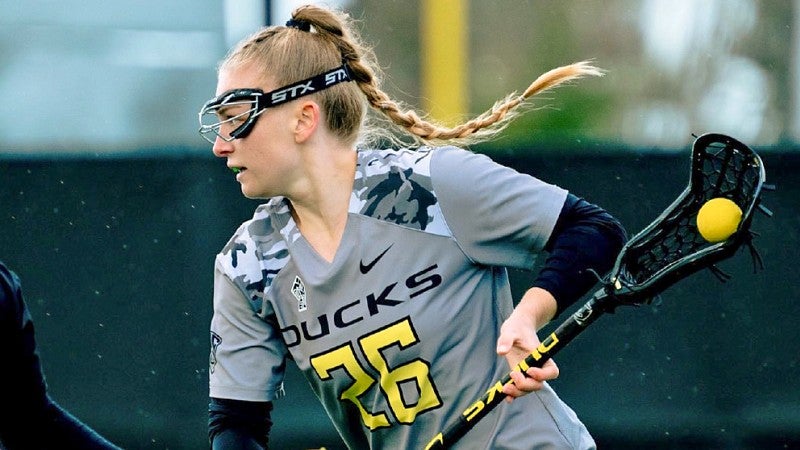
As a former UO Division I lacrosse student-athlete, Sperling had a personal connection to the world she was studying. She turned that interest into her media studies capstone project, “Progress vs. Reality: Are We Actually Advancing Women’s Sports?,” a 25-page study examining how women’s sports are represented in traditional and social media.
Now, as a sports production intern with ABC7 Los Angeles, Sperling is beginning her career in the sports media industry, where she works on player research, interviews, press conferences and original projects. The role allows her to apply the storytelling, research and communication skills she developed at the UO School of Journalism and Communication (SOJC) while gaining experience in professional sports production.
Her capstone research also shaped how she thinks about sports storytelling. After examining how women athletes can be framed through appearance, emotion and personality alongside their athletic achievements, Sperling said she now looks for the human experiences behind the headlines.
“Just find the humanity in others because that’s really what makes a great story,” she said.
Visibility is not the same as equity
Her experience in women’s sports prompted Sperling to explore what that increased coverage was saying about women as athletes.
“I wanted to look beyond the visibility because I didn’t think that visibility meant equality,” Sperling said.
To explore that question, Sperling compared coverage of women’s sports across traditional and digital media, examining how female athletes were portrayed through their athletic performance, emotions and physical appearance. She found coverage emphasized gendered expectations alongside athletic achievement.
“True equality requires more than just seeing all those increasing coverage numbers or those viral moments you see when you scroll,” Sperling said. “I think it’s more about how women athletes are framed, and it’s being consistent in recognizing them as elite competitors alongside all of their other successes too.”
One of the most surprising findings, Sperling said, was that increased attention to women’s sports did not necessarily mean female athletes were being recognized for their athletic accomplishments. Media coverage often emphasized athletes’ appearance, personality or personal lives rather than their performance.
For example, German runner Alica Schmidt has been widely described as the world’s sexiest athlete, a label that can overshadow her accomplishments on the track. Sperling also saw similar patterns in coverage of basketball stars Caitlin Clark and Angel Reese, where their rivalry and personalities became a major focus of media coverage.
“Those videos were getting way more views than Clark breaking a record,” Sperling said. “So that was very surprising to me because you don’t see that a lot in men’s sports.”
Sperling said the project reinforced the importance of looking beyond the surface when telling stories about others. She believes good storytelling requires understanding the people behind the headlines and recognizing their experiences beyond the way they are portrayed in the media. She encourages future journalists and communicators to use their platforms to tell stories that help audiences connect with people.
“I think in our world, there’s so much that goes on, and people just want to see the human side of other people,” Sperling said. “So if you can touch on that, that’s really how you resonate with people and connect audiences around the world.”
The project also changed the way Sperling thinks about the stories she encounters and tells. “Good storytelling isn’t just what you’re covering and what happens,” she said. “It’s about understanding why those stories matter.”
Whitney Hunter is a fourth-year journalism student in the UO School of Journalism and Communication (SOJC) and a writer for the SOJC Communication team. She is also a member of the SOJC Honors program. Her interests include telling unique stories, travel journalism and exploring how communications and social media can connect people with the world around them.
Related Stories