
Ava Martinez gained research experience and found a pathway to digital marketing through hands-on learning opportunities.

by Peyton Gast, class of ’27
Two years ago, as a second-year student, Ava Martinez raised her hand in her Introduction to Media Studies class. The instructor had asked how many students were media studies majors.
Ava looked around the lecture hall and discovered that only she and one other person had their hands up. It was puzzling, she thought, that a class dedicated to media studies had only two media studies majors.
Her major was smaller than she thought.
“I think (the size) sets it apart from journalism, advertising and public relations,” Martinez said. She wondered if prospective students simply aren’t sure what it is, leading to fewer applicants.
The media studies major focuses on one of four research- and career-focused tracks: documentary study and production; media technologies and society; media structures and regulation; and culture, power and the media.
From Martinez’ perspective, the beauty of media studies is that it combines all the UO School of Journalism and Communication (SOJC) majors while looking at mass media. You can analyze advertisements and audiences. You can survey people for their perspectives. You can work with a team of people to discuss brand strategy.
Over time, Martinez found the small size of media studies to be a strength of the program.
“It’s kind of nice that there are only a few people in the major because you really know who everyone is,” she said.
The professors are no exception. Martinez remembers her first-year Global Communications class, taught by Diego Cortés, assistant professor of media studies. The class was one of those massive lectures with hundreds of people, where it’s nearly impossible for professors to remember students' names. But Martinez, now a junior, is taking Cortés’ Gilded Age class and was delighted to find out that he remembered her from years ago in Global Communications.
Now three years into the program, Martinez feels like her learning has become more productive. Her sights are set on digital marketing, and she can now visualize a future where she can apply her classroom learning to the real world ahead of her.
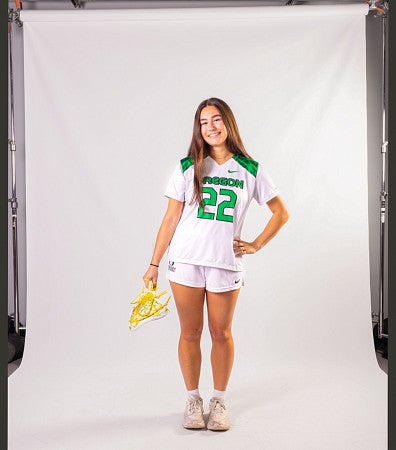
Taking advantage of an internship opportunity abroad
This summer, Martinez is heading to Lisbon, Portugal, for a two-month GlobalWorks internship. She landed the opportunity, in part, using the skills she learned in classes at the SOJC, like Writing as Practice. She also credits her media studies classes for teaching her how to market her resume to admissions staff and for stressing the importance of writing professional emails.
She’ll work for the language school Linguagest, where she’ll assess its marketing strategy, identify competitors and then iterate accordingly. It’s work that’ll never go out of style, Martinez said.
“There’s always room for new ideas and new people,” Martinez said. “There are always new technologies to implement and use.”
Being able to assess media and media strategies critically is becoming increasingly important.
“Everything is becoming digitalized,” she said. “I’ve learned how influential the media is on public opinion.”
Pairing food studies with media studies
In January, Martinez joined David Meek, the director of food studies in the College of Arts and Sciences, in his food sovereignty project called the Critical Agroecological Research Experience Lab. Meek’s team works with grassroots social movements in Latin America to promote education about food sovereignty. These organizations promote local control over the food system and food production education.
It was a position Martinez found with a little bit of luck and the helpful direction of SOJC staff. Her advisor told her it was time to choose a minor, and Martinez picked food studies. Then, in her Food Ethics class, the professor emailed information about a research position with Meek’s project. Martinez clicked, applied and got the position. Now she thinks it’s pretty cool how this opportunity bridges her major and minor.
The group, made up of UO students from all years and majors, Zooms with members of food sovereignty groups. Researchers like Martinez pose questions to the members, and, in Spanish, Meek interviews them. Afterward, the team translates the interviews into English and begins thinking about the best ways to get their stories out.
ArcGIS is one tool they use. It’s a storymapping platform that helps make complex data more visual and accessible.
In the role, Martinez learned about good interviewing techniques, ways to communicate information to a large audience and the satisfaction of interacting with people from around the world.
“I wasn’t sure where this path was going to take me,” Martinez said, thinking back to high school when she and her mom sat together looking through majors. Finding her passion for marketing came only once she took several classes and saw what interests stuck.
“I’m really glad that I chose media studies,” Martinez said. “I like how what I’m learning feels relevant and productive.”
Peyton Gast is a fourth-year journalism major at the SOJC with a minor in creative writing. She primarily works with audio and video, and she is passionate about recording voices and telling important stories loudly. You can find her work in Ascend magazine and The Daily Emerald as well as in its various magazines.