
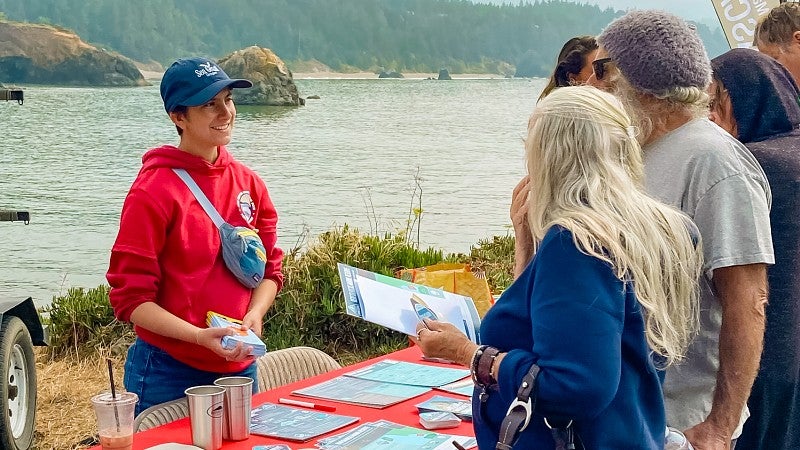
The science communication minor teaches you to translate complex science for the public, policymakers, and other audiences. Open to students of all majors, it blends the research behind effective science communication with hands-on story production, drawing on the SOJC's Center for Science Communication Research.
What Is Science Communication?
Science communication is an interdisciplinary field spanning both the research and the practice of conveying scientific findings to diverse audiences, including the public and policymakers. It works to strengthen the connections between science and society, solve problems through relationship-building, and move public understanding on issues that affect everyone, from climate change to public health.
Who It's For
This minor suits students who want to improve how science reaches the public, share research with other scientists, or tell stronger stories grounded in science. Whether you come from the sciences, journalism, or another field, you'll probe the intersections of science, communication, technology, and media. Open to students of all majors, its flexible coursework blends theory and practical skills around the most pressing science communication issues of our time.
Careers and Outcomes
Nearly every field that touches science now needs people who can communicate it clearly, and this minor prepares you for that work. Graduates are positioned for roles in science, health, and environmental communication, science journalism, public information and outreach, and communication for research institutions, nonprofits, and government agencies.
For students in the sciences, the minor adds the ability to explain your work to funders, decision-makers, and the public — a skill that strengthens research, policy, and academic careers. For students in communication and media, it opens a specialized and growing niche where subject expertise is in short supply.
How It Works
The science communication minor requires 24 credits that you can complete at any point in your degree: three required courses and three electives. The elective range lets you build a path suited to your interests in research, story production, or both.
For SOJC majors, only one JCOM course can count toward both your major and your minor.
Required Courses — 12 credits / 3 courses
Two UO science courses
Take any two courses that meet UO's science core education requirement. These must be graded and passed with a C or better; we recommend completing them before JCOM 385.
JCOM 385 The Science of Science Communication 4 credits
Explore the foundations of the growing field of science communication, examining real communication challenges and the research into how the public connects — or doesn't — with science messaging.
Elective Courses and Experiential Learning — 12 credits / 3 courses
Choose any three from the courses below. Topics courses are repeatable for credit when the topic changes.
JCOM 410 Living in Our Valley 4 credits
A place-based storytelling course exploring multimedia techniques through the environmental issues of the Willamette Valley.
JCOM 438 Science Story 4 credits
An advanced, place-based reporting course focused on the southern Willamette Valley, working through a rigorous process to publish science and environmental reporting that's accurate, clear, and accessible.
JCOM 485 Science Communication and Decision Making 4 credits
Study decision science, numeracy, and health and environmental communication, examining how strategic communication can help people use complex science to make better decisions.
JCOM 486 Environmental Communication Strategies 4 credits
Explore how public relations and advertising have shaped public understanding of environmental issues, with a focus on constructive climate conversations.
JCOM 487 Ecological and Social Justice Communication 4 credits
Learn how environmental and social justice issues are communicated, and develop accessible communication strategies for a more justice-oriented world.
JCOM 488 Topics in Science of Science Communication (titles vary) 4 credits
Take a deeper dive into science communication topics, including advanced health, strategic, and environmental communication.
JCOM 489 Topics in Science Communication Production (titles vary) 4 credits
Create science stories that build research into the process of tailoring strategy to specific audiences.
One UO science course (elective option)
One of your three electives can be a pre-approved 300- or 400-level course from another UO science subject, provided it includes a communication or engagement component. Contact the director to get a course pre-approved.