
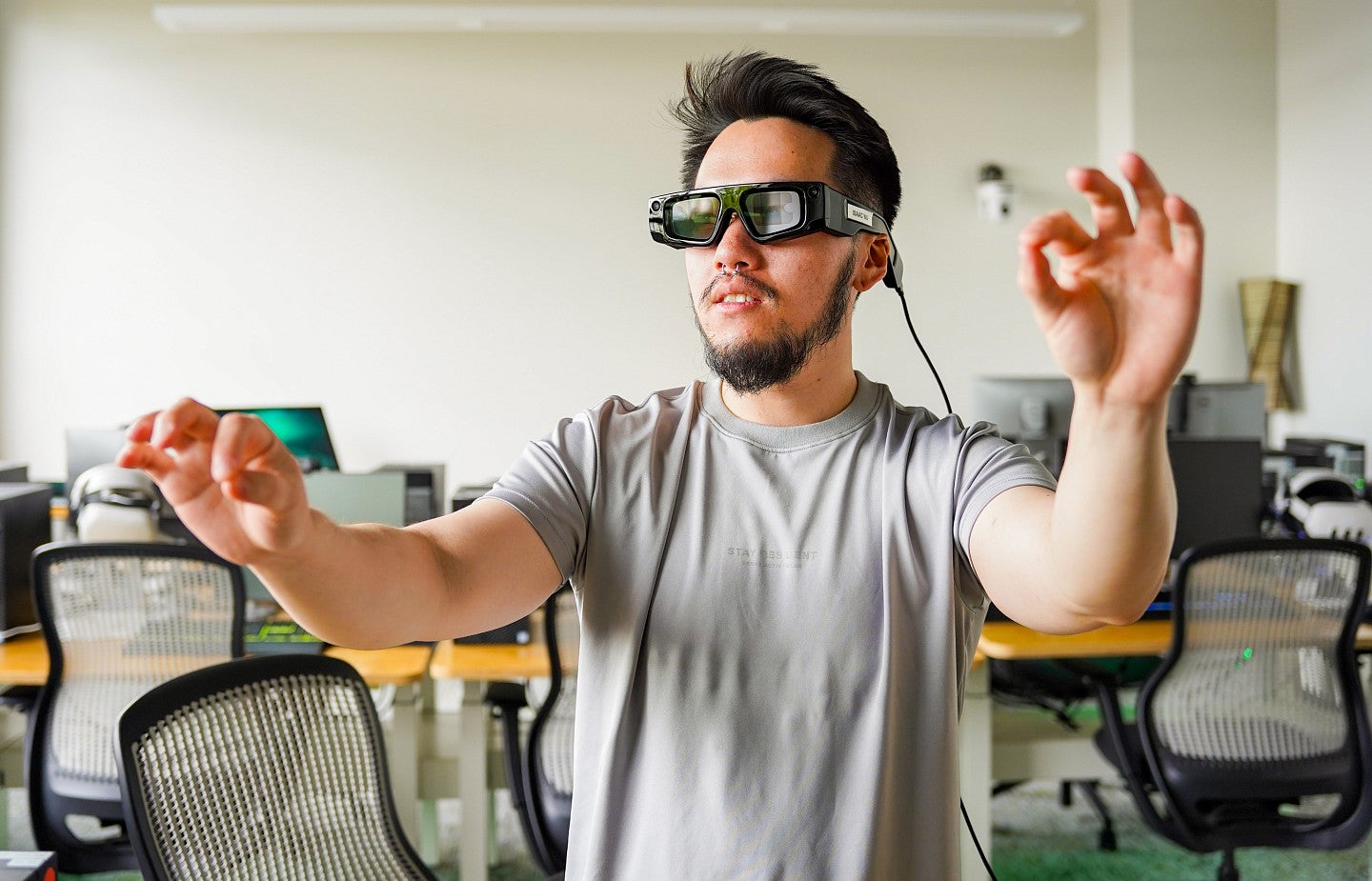
Isaac Wu traded business theory for hands-on design, and now he's building extended reality experiences that help people understand science.
by Ethan Donahue, class of ’26
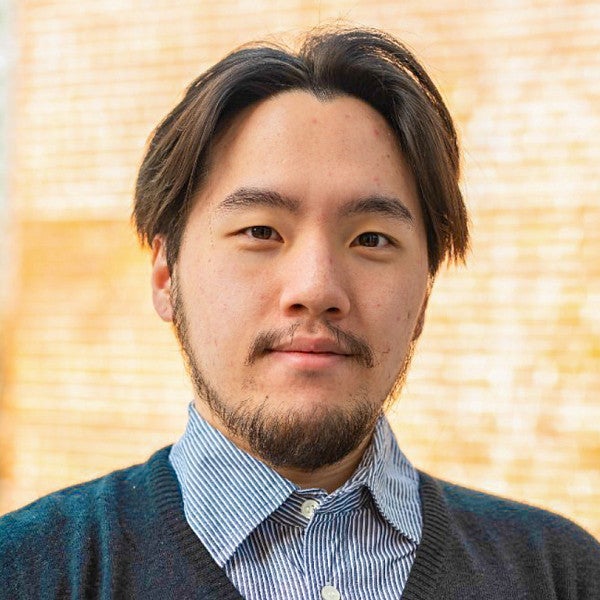
Meet Isaac Wu ’26
Biggest accomplishment so far:
Getting accepted into the well-known hackathon MIT Reality Hack, where I built meaningful connections with experts in emerging technology. It was a transformative experience that combined everything SOJC taught me about storytelling.
SOJC faculty or staff who made the biggest impression:
Danny Pimentel and Donna Davis both had a profound impact on me. Seeing their research, case studies and projects on how immersive technology could revolutionize storytelling was the main reason I started developing content for VR and AR. They showed me that this was not just a trend, but a new frontier for meaningful communication.
Most useful experience at UO:
Learning how to apply my knowledge in copywriting and art direction to present myself and my projects effectively gave me the ability to control my own narrative and truly express myself, both inside and outside of college.
Best thing about the SOJC:
My cohort went through a lot of chaotic and unpredictable events together during our college years. Those experiences helped shape our characters and taught us to be grateful for every opportunity that comes our way. We learned that things can change in an instant, and if you are not prepared, opportunities can pass you by.
For Immersive Media Communication Master’s student Isaac Wu, a shift away from business and toward creative work became the first step on a path defined by curiosity, experimentation and a growing passion for immersive technology.
When Wu first arrived at the University of Oregon as an undergraduate, he started in the Lundquist College of Business, drawn to its practicality and career options. But in time, he realized he wanted something more hands-on.
That led him to switch to advertising at the UO School of Journalism and Communication (SOJC), where he experimented with and learned production, photography and design. This also allowed him space to foster his interest in digital tools, such as augmented and virtual reality, as a means of communication.
“I switched because I just feel like the business was too focused on theory,” he said. “I felt more grounded when thinking of doing something tangible.”
After earning his degree in advertising in 2022, Wu didn’t immediately return to school. Instead, he worked as a remote user-experience (UX) designer for the Human Health Project, Positive Planet US and Kingdomly. These roles gave him hands-on experience designing for real users and taught him about accessibility, interaction and how people move through digital spaces.
Around the same time, Wu’s curiosity about emerging technology began to grow. He found himself drawn to extended reality (XR) — an umbrella term covering immersive technologies that blend physical and digital worlds, including virtual reality (VR), augmented reality (AR) and mixed reality (MR) — and the possibilities it opened up for storytelling and design.
“I feel like there are just so many possibilities,” he said.
After serving a year of required military service for the Republic of China (Taiwan) Marine Corps, Wu was eager to return to the U.S. and to the SOJC.
Immersive media storytelling formats drew him back to the SOJC
Coming back to the SOJC for the Immersive Media Communication Master’s program felt like a natural next step for Wu.
Part of that decision was rooted in his undergraduate experience. While working on the SOJC Ad Team, he had been exposed to real-world projects and met faculty working in emerging media. Those moments stuck with him, showing him that storytelling could extend far beyond traditional formats.
His work now centers on using immersive technology to create engaging and meaningful educational experiences.
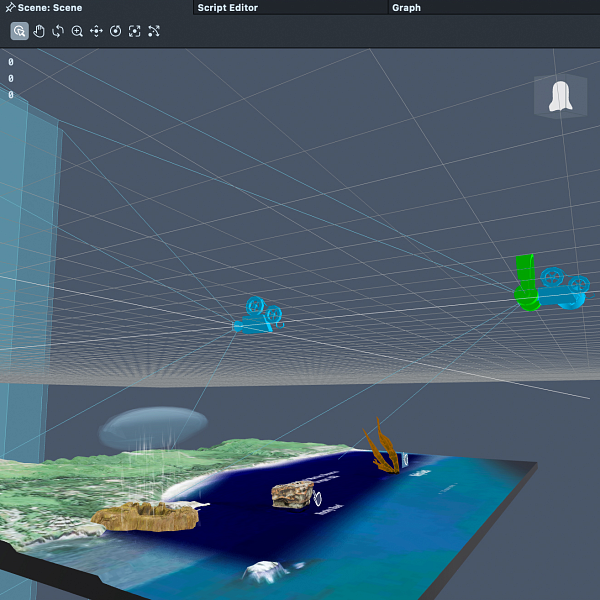
One of the most defining parts of his graduate experience has been his work on an augmented reality experience focused on ocean conservation along the Oregon Coast at the Otter Rock Marine Reserve, created by the SOJC’s Snap AR Scholars team.
Developed in collaboration with the Oregon Department of Fish and Wildlife, the project aimed to help everyday visitors better understand the ecosystems around them, especially the parts that aren’t visible.
“A lot of times, there are so many things going on in the ocean, and nobody really knows that,” he said.
Exploring user experience and wearable technologies
Working on the design side of the project, he helped develop the user experience, building prototypes, shaping the narrative and thinking through how people would interact with the environment. His role required him to transfer his UX knowhow to a new medium.
The project also explored different formats, including mobile AR and wearable technology like Snap Spectacles. Each offered a different level of immersion, but the glasses, in particular, opened up new possibilities.
“With the glasses, you were able to move around to mimic the actual feelings and experience,” he said.
The spectacles allowed users to move through the simulation and interact with various elements while still being aware of the surrounding area. This gives users a more in-depth way to experience the story. The project was shown at the Oregon Coast Aquarium and received positive feedback and engagement from visitors. The project earned a 2026 Webby Awards honorable mention.
Working in XR space exposes Wu to potential of immersive tools
Alongside his graduate coursework, Wu now works as an XR solutions technician for VEDX Solutions, an Oregon-based company focused on implementing immersive technology for training and education.
“My job is to help clients with troubleshooting and expand their experiences,” he said.
The role gives him exposure to a wide range of XR tools and highlights how widely the technologies are being implemented on both professional and academic levels. Much of that work is supported by his time as a lab assistant at the SOJC’s Oregon Reality Lab, where he helps newbies navigate emerging technologies.
That experience has shaped how he approaches design, not just focusing on what’s possible, but on what’s accessible and intuitive for users first encountering these tools.
Recently, he completed his first in-person XR deployment on the East Coast with VEDX, working directly with users and seeing how people interact with immersive technology in a live setting.
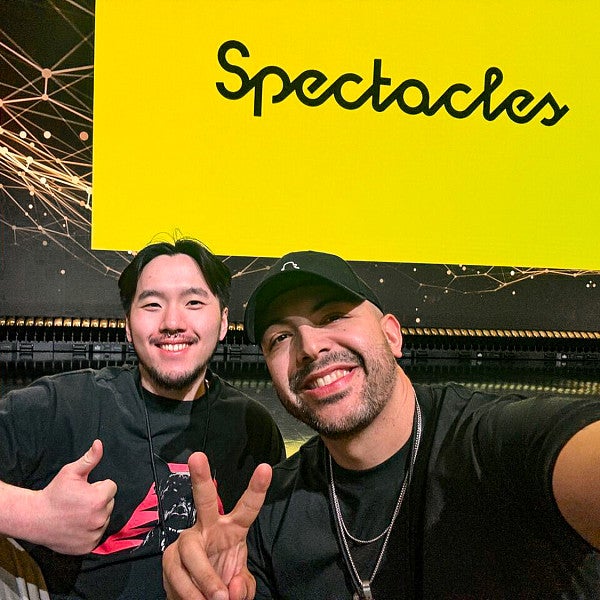
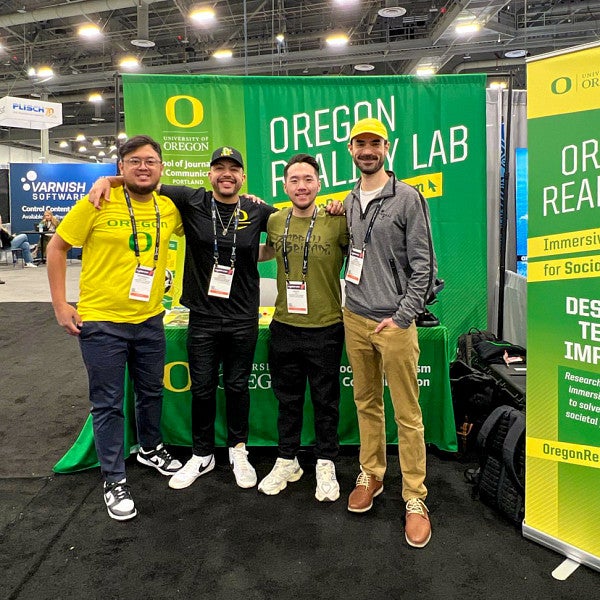
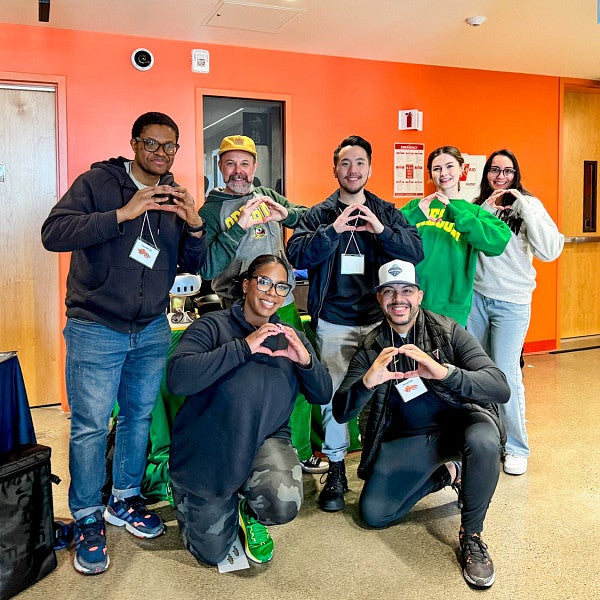
Immersive Media Communication Master’s student Isaac Wu’s work has taken him far beyond the UO campus. Pictured at left, Wu was invited to Snap headquarters in Los Angeles for the first Spectacles developer technical workshop in April 2026 along with his mentor, Assistant Professor Danny Pimentel. At right, Muhummad Alfarisi, Pimentel, Wu and Sam Morrison staff the Oregon Reality Lab booth at the NAB Show in Las Vegas in 2025. Photos courtesy of Isaac Wu.
Bringing AR experiences to education and environmental awareness
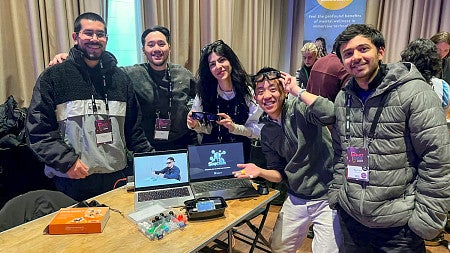
Wu also participated in the 2026 MIT Reality Hack, where he worked with a team of peers to develop a Snap Spectacles experience called SnapChem. SnapChem integrates AR and AI with a physical molecular model kit, allowing students to visualize and interact with chemical structures as part of their chemistry coursework.
Wu believes that such learning models will become more common in the classroom due to their hands-on qualities and easy implementation into the classroom.
Outside of his coursework and job, he continues to develop his own projects, often centered on education and environmental awareness.
“I really want to be in touch with the applied side: training, entertainment and education,” Wu said.
His current work includes an AR experience designed to teach users about beekeeping and environmental systems, as well as collaborating with Viverse on a VR project focused on wildfire prevention. Both reflect a broader goal: using immersive technology to make complex topics more understandable and engaging.
“I want to be someone who can impact the world,” Wu said. “Not just environmentally, but also considering social justice.”
As he prepares to graduate, Wu knows there’s still more to learn, especially on the technical side.
“I want to really spend time working on more projects and learning more about coding,” Wu said.
He wants to continue working in XR, moving deeper into design and development while creating experiences that have real-world impact.
He also sees immersive technology becoming increasingly integrated into everyday life, particularly through wearable AR.
“I would definitely think it’s going places, especially as people find it more appealing and interactive,” he said.
For him, the appeal of XR isn’t just the technology itself; it’s what it makes possible: a way to tell stories differently, a way to teach people more effectively and a way to connect individuals to the world around them in ways that feel immediate, physical and real.
And for now, that’s exactly where he wants to be: at the intersection of storytelling, technology and possibility.
Ethan Donahue is a journalism major with a double major in history. He is part of the School of Journalism and Communication’s direct-admit and honors programs and a student in the Clark Honors College. He is interested in investigative and conflict journalism and is working on a thesis focusing on how journalism, propaganda and the U.S. government interact during conflicts.