
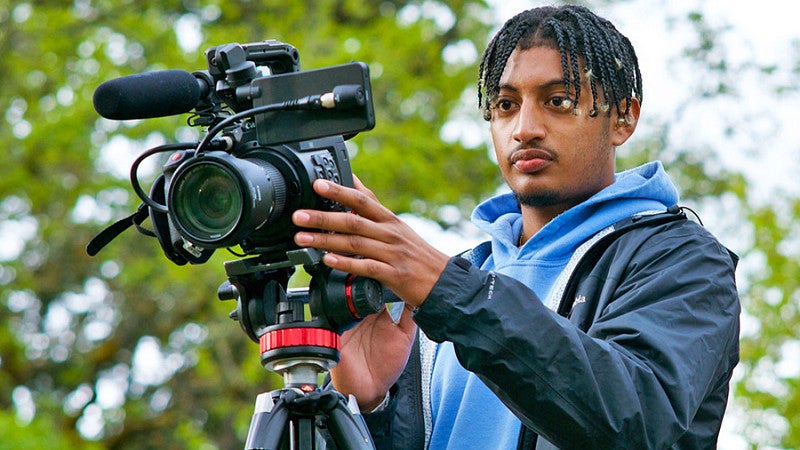
The documentary film production minor teaches you to research, shoot, and edit nonfiction films that tell true stories about people, events, and ideas. Open to any UO major, it adds hands-on production skills to your degree through a six-course sequence taught in the SOJC's media studies area.
What Is Documentary Film Production?
Documentary film production is the craft of creating nonfiction stories that explore people's lives, events, and ideas through inspiring and informative narratives. Documentary filmmakers work across subjects including culture, politics, sports, science, and the natural world, using research, interviews, cinematography, and editing to bring real stories to the screen.
Who It's For
This minor suits students who want to add hands-on production skills to their toolkit and tell true stories about the human experience. If you're drawn to documenting the real world and its social, environmental, political, and personal issues, the minor gives you the technical and creative foundation to do it. It's open to any UO major and pairs especially well with journalism, cinema studies, anthropology, environmental studies, romance languages, women's and gender studies, or indigenous, race, and ethnic studies.
Careers and Outcomes
A documentary minor builds skills that transfer across media and storytelling careers. You'll graduate able to plan, shoot, and edit nonfiction video, the same work at the center of documentary and nonfiction film, video production, broadcast and digital journalism, and multimedia storytelling. The minor also prepares you for nonfiction video work in nonprofit, advocacy, and organizational communication, where storytelling supports fundraising, outreach, and public awareness. Paired with your major, it can deepen careers in fields like journalism, anthropology, environmental work, and the arts, where the ability to document and share real stories is an asset.
How It Works
The documentary film production minor requires 24 credits (six courses), which you can complete at any point in your degree. All six are taught through the SOJC's media studies area and build in sequence, from documentary foundations through a three-course production sequence where you research, shoot, and edit your own film.
For SOJC majors, only one JCOM course can count toward both your major and your minor.
Required Courses — 24 credits / 6 courses
JCOM 220 Introduction to Documentary Production 4 credits
Learn the fundamentals of conceptualizing, developing, and producing a documentary film, along with documentary history and basic theory.
JCOM 320 Survey of the Documentary 4 credits
Build a broad knowledge of documentary styles, approaches, and categories through the form's most significant examples.
JCOM 321 Documentary Filmmaking Aesthetics 4 credits
Work with the aesthetics of the moving image — framing and composition, light, color, sound, and editing — to develop an informed creative approach to visual problem-solving.
JCOM 420 Documentary Pre-Production 4 credits
Research, plan, budget, and develop a documentary idea into a proposal. You'll produce a sizzle reel and pitch your project, then carry it into JCOM 421. (First of the three-course production sequence.)
JCOM 421 Documentary Production 4 credits
Turn your proposal into a documentary film, sharpening your shooting, producing, and directing skills. (Second in the production sequence.)
JCOM 422 Documentary Post-Production 4 credits
Edit as a creative process and learn the business of distribution, completing a finished documentary and learning to share it at festivals, through distributors, and by self-publishing. (Third in the production sequence.)