
Alum Alec Freudenstein, MS ’24, created a virtual financial advisor for his Immersive Media Communication master’s terminal project. It helped him land a job at an AI research lab.
by Lily Reese, Class of ’27

Meet Alec Freudenstein
Current job:
Founding account executive at Hume AI
First job out of college:
Product manager at Sapience Analytics
Biggest career accomplishment:
The thing that I'm most proud of is betting on myself. I don't think there's a better bet than betting on yourself.
SOJC faculty or staff who made the biggest impression:
Danny Pimentel was so generous with his time that anytime I was like, “Danny, I have this idea. What if I did this? What if I did that?” I could just text him, and he was just so responsive.
Best thing about the SOJC:
The most valuable thing you get out of this is the connections to the other 15-20 people with whom you're doing everything.
From self-taught 3D designer to co-creator of a voice AI-powered financial advisor, Alec Freudenstein’s best tools are his creativity and curiosity.
Freudenstein, MS ’24, turned his capstone project for the UO School of Journalism and Communication (SOJC) Immersive Media Communication Master’s program into a prototype that was recognized by some of the biggest firms in AI development. That work propelled him to Hume AI, a leader in empathic AI research.
Freudenstein graduated from Tulane University with a bachelor’s degree in business, and in 2017, he began working for Sapience Analytics, a startup that provides workforce analytics on employee productivity. At Sapience, he wore many hats: marketing, operations, customer success — and developed a versatile skill set that later helped him navigate the intersection of AI and immersive technology.
When the COVID-19 shutdown hit, “people analytics” surged as remote work became the new norm, and Freudenstein saw firsthand what a rocketship startup looked like. It also sparked his interest in exploring alternative career paths and new opportunities.
During the pandemic, while many were mastering sourdough, Freudenstein was teaching himself 3D motion graphics. His fascination with animation, which started as a child while watching Pixar films, found a new focus during the pandemic. As he honed his craft, he also discovered ChatGPT and quickly came to understand the profound impact AI would have across industries. He recognized that the work he was doing, creating motion graphics manually, could soon be done far more quickly by AI.
“I knew something extraordinary was about to happen,” Freudenstein said. “I needed to position myself in the right place at the right time, and I knew that place was immersive technology.”
Freudenstein was certain he wanted a career in the immersive tech industry. He sensed that AI and immersive technologies would reshape the landscape, but he needed time to sharpen his skills.
“I had to buy myself time, because many of the companies I wanted to work for didn’t even exist yet,” he said. “I needed a way to practice, to prepare and then strike when the iron was hot.”
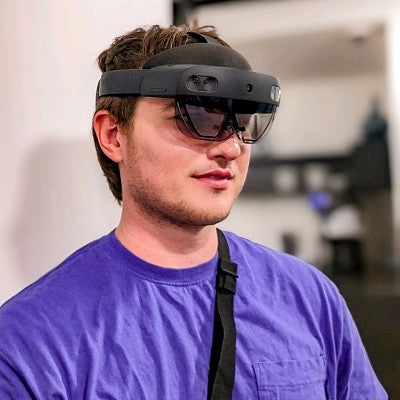
Finding the Immersive Media Communication Master’s program
Freudenstein joined the inaugural IMC cohort at SOJC after reading an article that drew him to the program’s innovative mix of storytelling, design and AI. He treated the program as a creative sandbox, exploring how immersive experiences could build trust between humans and AI.
As a New Yorker, he was one of the few fully online students, yet he stayed deeply connected. “The most valuable part was the connections, the camaraderie, bouncing ideas off classmates, and support from staff,” Freudenstein said. “It felt like being part of a community.”
That sense of community extended beyond the classroom, Freudenstein recalled. “Facetiming classmates late at night when something was due, or talking through ideas with peers about where the future was heading — most of my group ended up being right.”
When he eventually met them in person, they seemed like old friends. He also built lasting relationships with faculty, particularly Danny Pimentel and program director Donna Davis, who supported him in all his endeavors.
“Danny was huge for me,” he said, recalling their first in-person meeting at Snapchat’s LensFest in Santa Monica, where Freudenstein represented Hume AI and their client, Niantic Labs, the creators of Pokémon Go. Freudenstein was with Niantic, showcasing a voice AI-powered geospatial companion for Snapchat’s augmented reality glasses, a character that walks alongside users, responds to them and guides them through experiences.
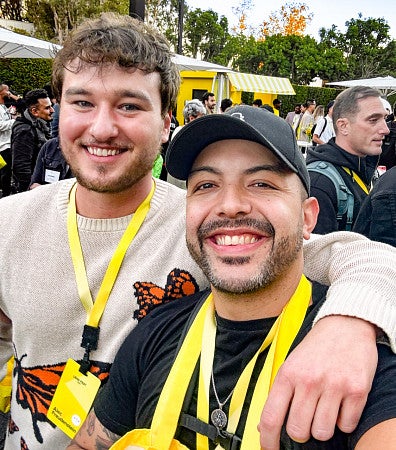
“It was incredible to see the project come to life using Hume’s technology for the character’s voice,” he said. “Being there with Danny, showing him that I had gone from his student to a professional in the field, felt like a full-circle moment.”
Turning a capstone project into a business
For Freudenstein, the program’s value went beyond grades. “Sometimes people expect a master’s program to hand them a job. That’s not how it works,” he said. “The best advice is to make something, anything. Have something to show: ‘Look what I made while I was here.’ That’s what opens doors.”
FinLit, his capstone project, became that “something.” Inspired by his own struggles to find high-quality advisory information, Freudenstein created Penny, a virtual financial advisor capable of conversational, emotionally intelligent interactions. The project showcased how immersive media could make complex topics accessible and foster trust between humans and AI.
In early 2024, Freudenstein transformed FinLit from a capstone project into a full-fledged prototype. Central to this leap was his partnership with Eduardo Joia, then chief technology officer of financial services at Microsoft.
The connection wasn’t new; Freudenstein had met Joia years earlier during a job interview right out of college. He hadn’t landed the role, but he had kept the relationship alive, nurturing it over time. That long-term connection paid off, becoming the bridge that helped turn an academic idea into a real-world venture.
“Because I built the capstone project using voice AI in an innovative way, I was able to position myself for a role at one of the top AI research labs in the country,” he said.
At Hume AI, Freudenstein works on empathic voice AI, powering technologies that interpret and respond to human emotions. As an alum, he continues to engage with UO, collaborating with faculty on research and guest-lecturing in classrooms. But Freudenstein wants to give back even more, especially with his new position at Hume.
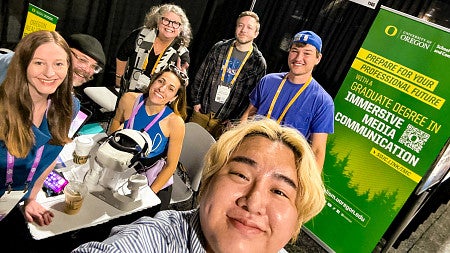
One research opportunity Freudenstein would be particularly interested in would be for Hume to co-author a research paper with the SOJC IMC program on user feelings of trust in AI voice agents. Such a collaboration would benefit both the SOJC and Hume.
Freudenstein is impressed with the way the Immersive Media Communication Master’s program has fostered a sense of belonging. “It’s not just, ‘Here’s your certificate, get out,’” he said. “They want us around, to talk to prospective students, to stay part of the community. That feels really nice.”
Reflecting on his journey, Freudenstein emphasizes the value of following his instincts. “I think the thing I’m most proud of is trusting my gut, using what I had and betting on myself,” he said. “Whether that was putting myself through grad school or trusting that immersive tech would change the world, investing in myself first has been the best investment of all.”
Lily Reese is a third-year journalism major at the SOJC, with a minor in food studies. She is passionate about storytelling, sustainability and lifelong learning. Lily loves to write, and you can find her work in Ethos magazine, Align magazine and now she is a writer and copyeditor for Ascend Magazine.