Three master's students turned a first-term assignment into a national PR championship.
by Lily Reese, class of ’27
What began as a first-term class assignment became a national championship for three students in the SOJC’s Strategic Communication Master’s program.
The team of graduate students took first place in the Institute for Public Relations and Page Society Case Study Competition with their project “Veritas v. Trump: Tracing the Tensions Between Institutional Autonomy and Federal Authority.”
Their winning case study examined how Harvard University navigated mounting pressure from the Trump administration, balancing legal action, strategic messaging and stakeholder communication while facing significant reputational and financial challenges.
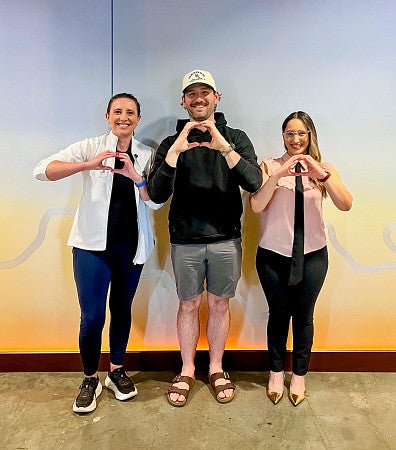
For team members Benjamin Schorzman, Erin Taylor and Yuritza Sandoval, the project began in their first graduate course, Foundations of Strategic Communication, taught by Strategic Communication Program Director and Professor Donna Davis.
“We started from zero,” Sandoval said. “I remember feeling a little embarrassed because I didn’t even know what a case study was. Neither Erin nor Ben knew exactly what to expect either. Looking back, it’s funny to think that we started from not knowing what a case study was and ended up winning a national competition."
Case study team analyzed financial documents, news accounts and public records
Over the course of the fall term, the team spent months researching, analyzing and writing. Their final report grew to roughly 40 pages and incorporated more than 50 sources, including university financial documents, news coverage and public records.
As they worked through hundreds of pages of reporting and documentation, the team also incorporated artificial intelligence tools into their research process. Schorzman said AI helped the group organize competition guidelines into a working checklist, identify gaps in their draft and synthesize large amounts of source material.
“The very first thing I did was put the guidelines into chat and asked it to come up with a checklist," Schorzman said. “It was our map. It was our North Star.”
Schorzman said he also used NotebookLM to create executive summaries of source materials, helping him identify key themes before returning to original documents and sources to complete the writing.
While technology helped the team organize information, the project ultimately relied on the unique perspectives each member brought to the table.
The team's professional backgrounds helped shape the project. Schorzman, who works in communications for the UO Office of the President, brought storytelling and writing expertise. Taylor, an associate director of UO University Advancement, contributed financial and fundraising perspectives. Sandoval, who is an eligibility specialist for Multnomah County, provided extensive research and a broader perspective informed by her bilingual background.
“It was a really nice marriage of our areas of expertise,” Taylor said. "Ben brought the communications expertise, and I brought the advancement and fundraising expertise, while Yuri brought a really wonderful outside-of-the-weeds perspective.”
The team’s analysis was strengthened by lessons learned across the Strategic Communication Master’s curriculum. While the case study originated in Foundations of Strategic Communication, students also drew on concepts from Media and Society, taught by Davis, and Finance for Strategic Communication, taught by Gudrun Granholm.
Taylor credits the finance course with helping the team connect communication decisions to organizational impacts.
“The committee was really impressed with the depth of financial analysis that our case went into,” Taylor said. “We learned in finance class that you really do have to follow the money. I think the fact that we did set our case apart.”
Faculty mentorship also played a significant role. Throughout the process, Davis provided feedback, encouragement and critical guidance as the team refined both its written submission and competition presentation.
“I can't say enough good things about Donna,” Schorzman said. “She was able to balance being a cheerleader while also giving us the honest, critical feedback we needed.”
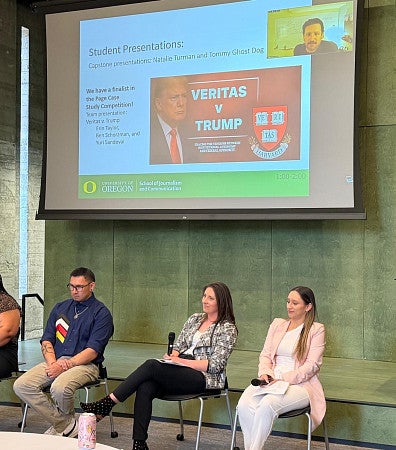
Months after completing the assignment, the team learned they had been selected as finalists and would present their work to a panel of judges. After updating their presentation and preparing for questions, they delivered their final pitch over Zoom.
Just hours later, they received the news that they had won first place.
Hard work and deep connections made the experience memorable
For Taylor, one of the most meaningful parts of the experience wasn’t the competition itself but the relationships that developed throughout the project.
During one meeting at a local pizza restaurant, the team discovered they all shared something in common: Each was the oldest sibling in their family.
“We came up with a team name, Big Sibling Energy,” Taylor said. “That's just our team. That's who we are.”
The nickname reflected the work ethic that teammates noticed throughout the project. Sandoval said the group consistently pushed themselves beyond what was required, creating internal deadlines and holding one another accountable long before official checkpoints.
More importantly, the project helped reinforce the value of bringing different perspectives to the table.
As a bilingual student whose first language is not English, Sandoval initially worried that she might hold the team back. Instead, she discovered her perspective became one of the project’s strengths.
“I was able to bring a different perspective because being bilingual gave me access to different articles, videos and debates,” Sandoval said. “It reminded me that a different background is not an obstacle. It allowed me to contribute something unique.”
For all three students, the experience demonstrated the real-world application of strategic communication principles and the collaborative nature of the program.“
It didn't feel like homework,” Sandoval said. “We were passionate about it.”
That passion, combined with careful research, interdisciplinary thinking and a little bit of big sibling energy, ultimately helped transform a classroom assignment into a national championship.

Lily Reese is a fourth-year journalism major at the SOJC with a minor in food studies. She is passionate about storytelling, sustainability and lifelong learning. Lily loves to write, and you can find her work in Ethos magazine, The Eugene Weekly, Align magazine and Ascend magazine.