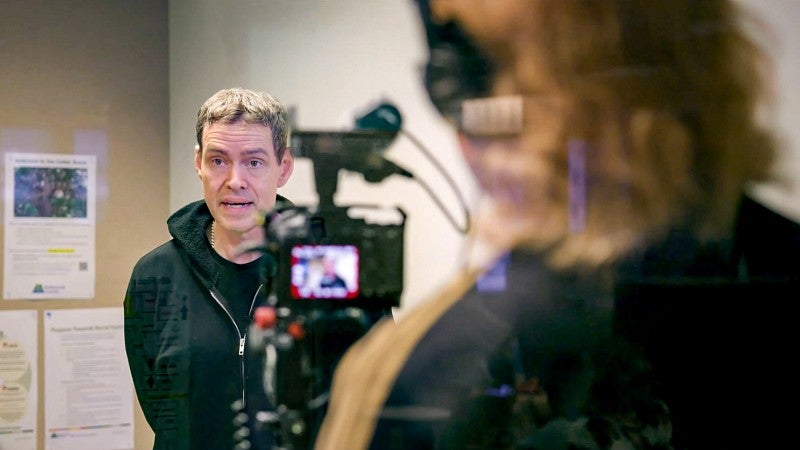
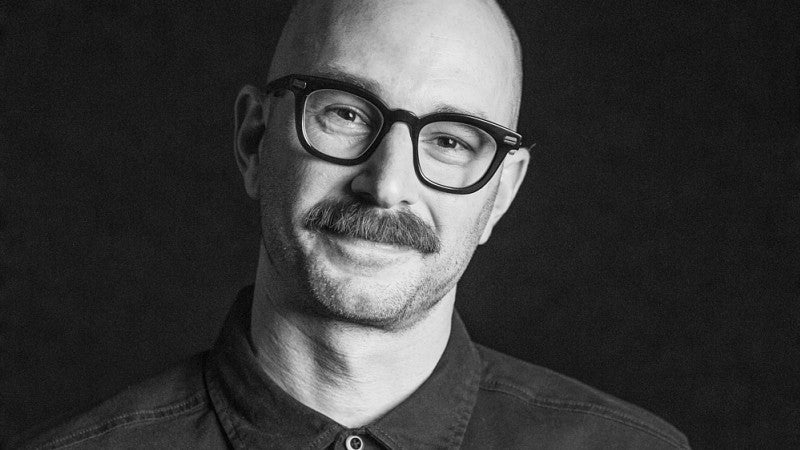
After years in scientific research, McKain and Kurt Williams returned to school for a Multimedia Storytelling Master’s to learn how to tell the stories behind the science.
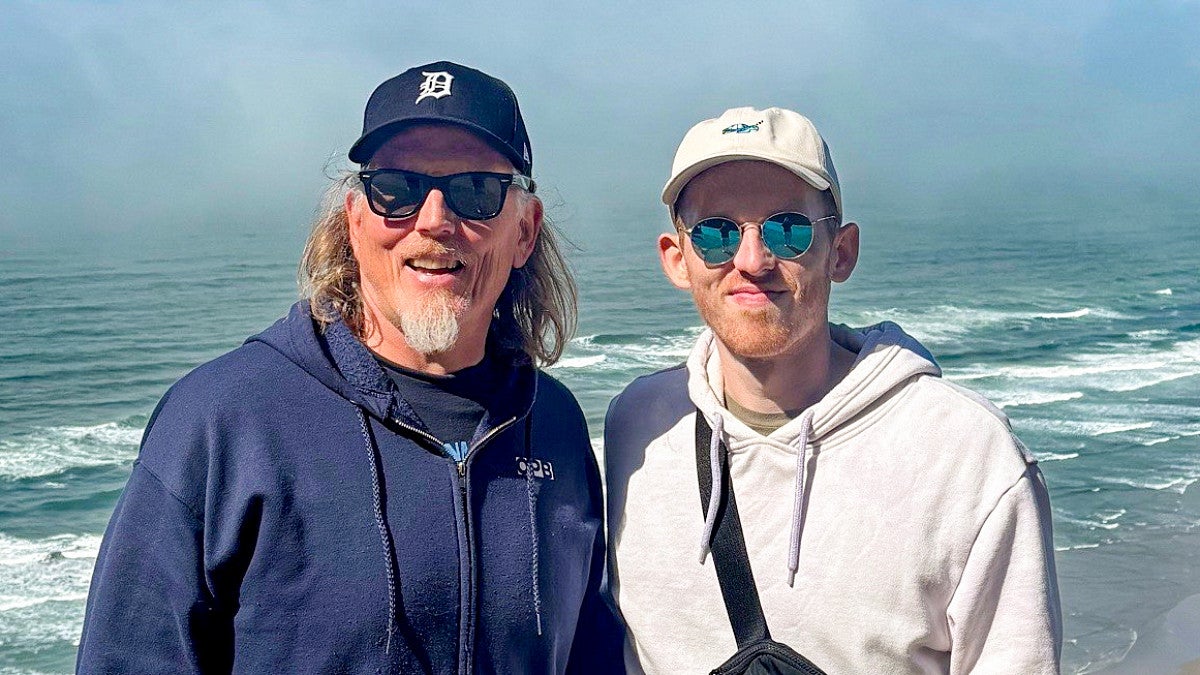
You expect a lot of things when you go back to school for your master’s degree. Your dad becoming your classmate probably isn’t one of them.
So when McKain Williams decided to pursue a master’s degree in multimedia storytelling at the UO School of Journalism and Communication (SOJC), he didn’t expect his father, Kurt Williams, to decide to do the same.
McKain graduated from Michigan State University with a degree in neuroscience in 2020. While doing biomedical research remotely during COVID at Michigan State he was working in Boston at Massachusetts General Hospital as a clinical research coordinator. This is where McKain started looking into attending medical school while also pursuing a Ph.D.
While applying and interviewing for both, he began to feel that the endless cycle of grants and administrative tasks may not be for him. With a waitlist for medical school at Oregon Health & Science University (OHSU) and grant money drying up for his work at Michigan State, McKain started a job in 2024 as the senior research assistant on OHSU’s HEALthy Brain & Child Development (HBCD) Study.
Yet he still found himself exasperated by aspects of scientific research.
“I’d become frustrated with communication about science,” McKain said. “The media can be so bad at conveying scientific ideas, cherry-picking what they want the stories to be, but then also, scientists are horrible at conveying the results of their studies.”
McKain's favorite part of research had always been the “stories from the data and the stories from the individual participants,” and that often wasn’t conveyed through science communication effectively.
“It felt like it wasn't affecting any sort of change whatsoever,” McKain said.
This feeling, coupled with his growing interest in the work of Rory Smith, a U.K.-based soccer journalist, showed McKain just how broad journalism and storytelling could be. Writing for the New York Times, Smith has expanded his reporting beyond the sport itself — profiling, for example, a gay couple purchasing a rugby team or chronicling the radical approaches England has taken to allow flooding to reclaim land.
Around the same time, he came across the SOJC’s Multimedia Storytelling Master’s program, which is tailored for working professionals. McKain could continue working at OHSU while learning video production, storytelling and other multimedia skills he felt were increasingly lacking in legacy newsrooms.
Using science communication to boost funding
Meanwhile, Kurt — who had been a faculty member at Michigan State University, where he completed a master of arts in journalism — moved to Oregon to start his current role as director of the Oregon Veterinary Diagnostic Laboratory (OVDL) at the Carlson College of Veterinary Medicine, at Oregon State University in 2022.
His journalism and storytelling background has served him well at the lab. It even helped him secure nearly $2 million in funding from the state of Oregon, demonstrating the practical value of his storytelling skills.
“But there are just endless, amazing stories coming out of the lab,” Kurt said.
Jens Odegaard (BA ’08), director of marketing and communications at Oregon State University’s College of Veterinary Medicine and a friend of Kurt’s, was the one who first told him about the Multimedia Storytelling Master’s. So when McKain mentioned the program, Kurt saw an opportunity to kill two birds with one stone: support his son while also gaining multimedia skills.
“I probably would have applied eventually,” Kurt said. “But I may as well maximize how irritating I can be to him in his lifestyle.”
The program’s structure, designed for working professionals with classes held at night, made it possible for Kurt to continue working while developing those same skills that enticed McKain.
“I suspect McKain probably thought it was horrible when I suggested it,” Kurt said.
Although McKain saw it at first as a little “strange,” he knew his dad was there for the same reason: to learn. From a parent’s standpoint, Kurt said, it has been especially rewarding to watch his son find his footing.
“Knowing how smart he is, it’s been super fun for me just as a dad to sit there and see him put together a project,” Kurt said.
The similarities between father and son extend beyond their decision to return to school. Both have found themselves drawn to stories at the intersection of science, the environment and people.
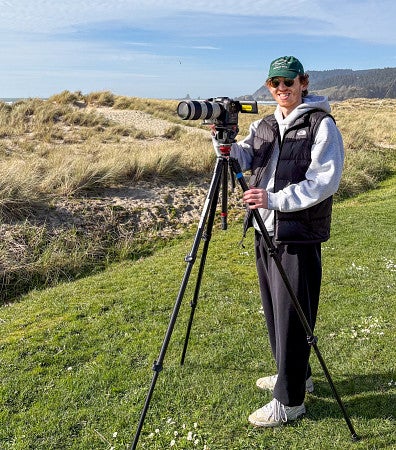
For McKain, that interest has taken him to the Oregon Coast, where his terminal project will focus on the conservation of tufted puffins.
Although still deciding exactly how he wants to tell the story, McKain has toyed with the possibility of a traditional documentary built around interviews with conservation experts. Another is a more observational, vérité-style film following the people doing the work, many of whom are volunteers.
“I’m interested in capturing the excitement that puffins evoke for some reason,” McKain said.
The challenge, he said, is making a story about science and conservation resonate with people who may not already care about either.
“Science and conservation can be dry if you’re not in that world,” he said.
That has become one of the central lessons McKain has taken from the program: A story shouldn’t only reach the people who already understand why it matters.
“If your audience is only people who already know that it’s happening, you’re just creating an echo chamber,” he said. “The idea is to make it appealing to everyone who might lay eyes on it.”
John Sutter, SOJC assistant professor of environmental media, has been particularly influential as McKain develops the project. With a background in climate- and environment-related filmmaking, he is overseeing McKain’s terminal project and helping him think about how to turn a scientific subject into a story that can reach beyond the scientific community.
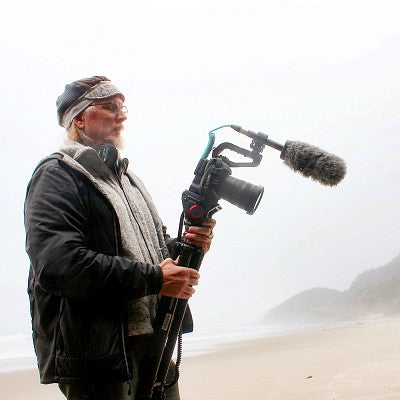
Documenting a man vs. nature dilemma
Kurt’s project takes a different route to a similar question: What happens when environmental issues put different communities at odds?
Since moving to Oregon from the Midwest, Kurt has become fascinated by the state’s coastline. As director of the OVDL, he has seen the consequences of that ecosystem up close. Marine mammals, including sea lions, are regularly brought to the lab after they die, giving Kurt a firsthand view of the animals and the challenges they face.
“Sea lions are an extremely controversial species on the coast,” Kurt said. “Tourists love them; many in the fishing community despise them.”
The conflict is complicated by Oregon’s endangered salmon and steelhead runs. Sea lions prey on salmon and, therefore, have become a source of tension among fishermen, conservationists, tourists and others along the coast. Kurt said some people have even taken matters into their own hands, killing sea lions despite legal protections.
For his terminal project, Kurt plans to narrow that sprawling conflict to one group: the people who dislike the sea lions.
The short film will be a starting point for a larger story Kurt hopes to tell. After completing the project, he plans to seek funding for a feature-length film exploring the broader conflict between sea lions, endangered salmon runs and the people who either love or resent the animals.
“It’s really interesting to me because the people who love them are absolutely head over heels for them,” Kurt said. “There’s this really interesting conflict between people who love sea lions, people who despise them, the sea lions themselves and the variety of endangered runs of salmon, steelhead and other species.”
In different ways, both projects reflect what drew the Williamses to multimedia storytelling in the first place: the belief that science becomes more meaningful when it is told through the people, places and conflicts behind the data.
Lily Reese is a fourth-year journalism major at the SOJC, with a minor in food studies. She is passionate about storytelling, sustainability and lifelong learning. Lily loves to write, and you can find her work in Ethos magazine, Eugene Weekly and Ascend magazine, where she is director.
Related Stories