
Hana Mazur, who is graduating with a Master’s in Advertising and Brand Responsibility, turned her adoption story into a Lego campaign.
by Lily Reese, class of ’27
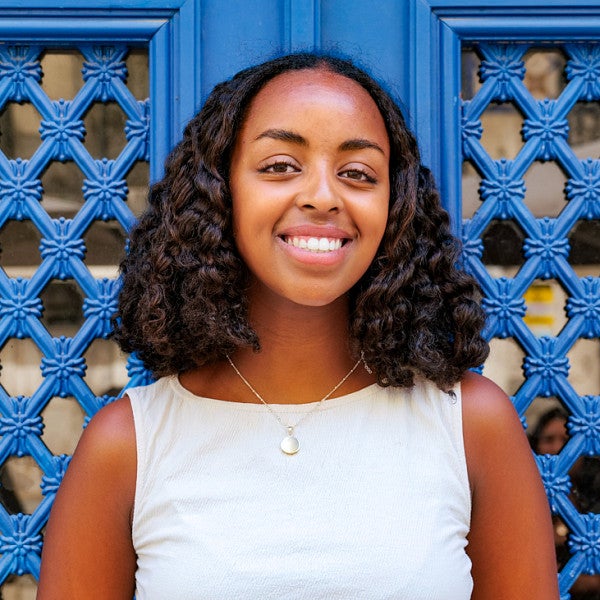
Meet Hana Mazur ’26
Biggest accomplishment so far:
It sounds so cheesy, but I would definitely say the people I've met and also the experiences. I feel like I've really taken full advantage of the SOJC.
SOJC faculty or staff who made the biggest impression:
I think Ed Madison is probably the number one. I just feel like he is more than a professor. He is also a friend and a mentor. And I feel like I could talk to him about anything, too, which has been really cool.
Most useful experience at the SOJC:
I know they don't have the class anymore, but Gateway. It kind of solidified things for me.
Best thing about your cohort:
We have so many personalities and styles in the class, and each person wants to do something different in their lives, but when we all come together, it's like we're still there for each other, and we still somehow understand each other's struggles and stress.
In the back of a Lego store, sorting through bins of tiny heads, torsos and accessories, Hana Mazur isn’t just building a family. She’s building a campaign.
For her terminal project in the Advertising and Brand Responsibility Master’s (ABR) program, Mazur has turned something deeply personal into a proposal that blends corporate social responsibility, storytelling and brand strategy.
At the UO School of Journalism and Communication (SOJC), ABR is not a traditional advertising master’s program. The first program of its kind, it stands out by merging traditional advertising strategy with brand accountability, sustainability and equity, training students to create a strong, positive impact on society. Students must complete a capstone project that illustrates how brands can add value through social good.
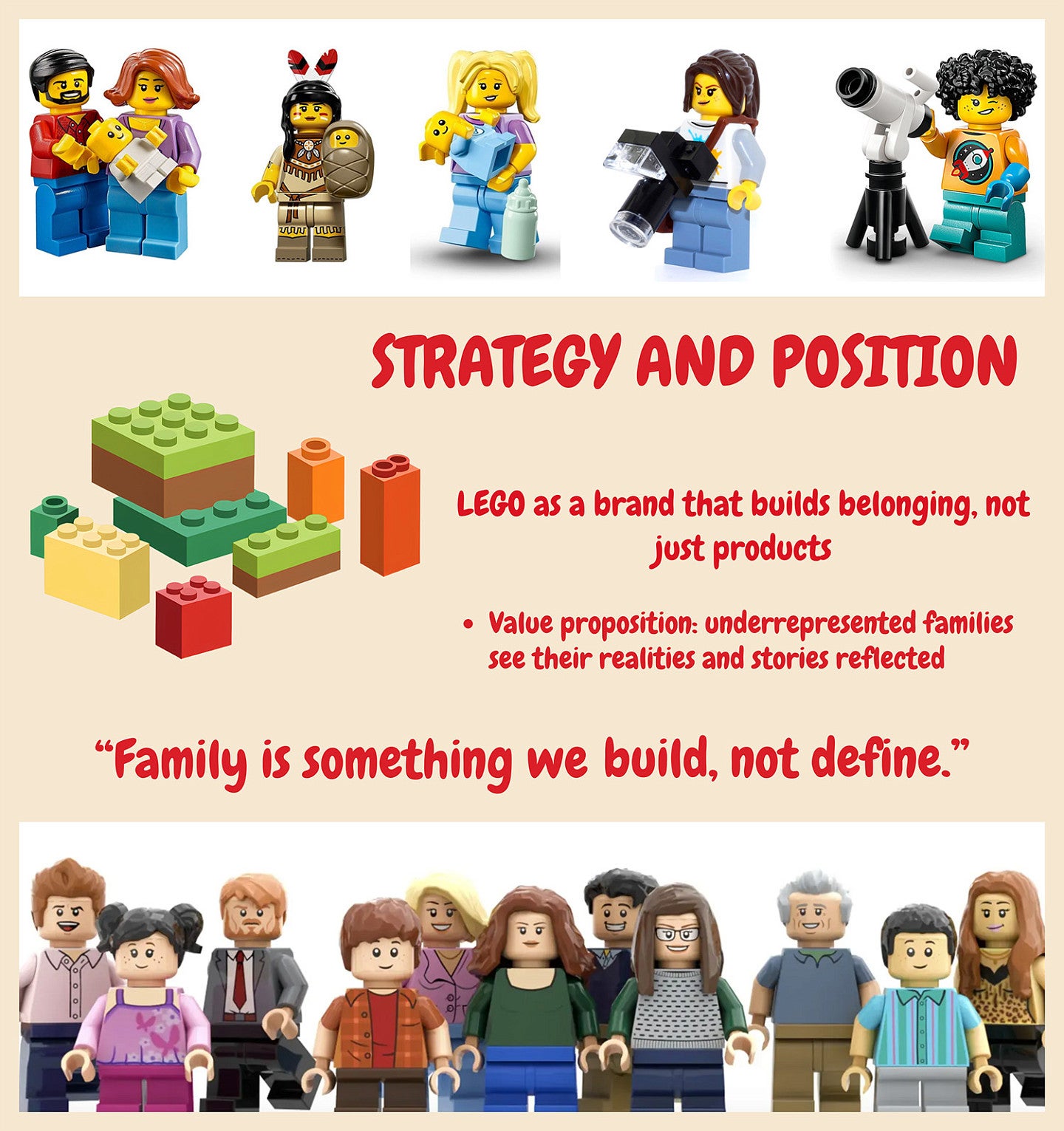
Mazur’s project, called Bricks of Belonging, connects Lego’s diversity and inclusion practices with a family-diversity concept borrowed from Camp To Belong, a summer camp where siblings separated by foster care reunite. In her campaign, Lego becomes more than a toy brand; it’s a medium for identity-building and reconnection.
Mazur’s Bricks of Belonging campaign is designed to commemorate National Adoption Month, using imagery and storytelling that emphasize diverse families — from foster and adopted families to blended families.
Mazur, who is adopted herself, said the idea stemmed from her own experience growing up.
“I'm taking my story and my family story as the starting point,” she said.
Through her research, she discovered that Lego has “really good practices with representation and inclusion,” so she liked the idea of centering Lego in her campaign.
From there, she built on the idea that, just as children piece together blocks of different sizes, shapes and colors to make Lego creations, her campaign would carry that idea to families.
Master’s program offers an authentic advertising experience
Mazur’s project sits at the center of a graduate experience shaped by collaboration, experimentation and constant revision. Across the ABR program, Mazur has moved between strategy decks, cultural projects and classroom exercises that often mirror real industry work more than traditional coursework.
“We’re not just doing tedious work,” she said. “Everything we create feels like something that could actually exist outside in the real world.”
That applied approach shows up throughout the ABR program. One of her most formative experiences came during her seminar class taught by Christopher Chávez, the SOJC’s Carolyn Silva Chambers Distinguished Professor of Advertising. The cultural jamming project assigned student teams to analyze real brands using a strategy and public relations frameworks, breaking down messaging and audience perception.
Her group created a campaign, “Too good for its own good,” which outlined the hazards of noise-cancelling headphones, such as reduced social interactions and impaired environmental awareness.
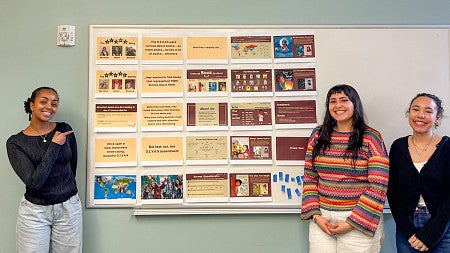
Those exercises evolved further in the class Advanced Curiosity for Strategists, led by Slavka Eberhart-Garah, where Mazur and classmates Mariana Marquez and Simone Hunnicutt developed a DEI literacy campaign. The group took an unconventional approach, inserting themselves into the work as a collective persona: the DIVAS — diversity, inclusivity, versatility, adaptivity and strength.
They conducted interviews with parents and faculty, gathered survey data, and built a children’s book aimed at helping children find reading materials that offered diversity and representation.
When they presented, the ABR students fully stepped into their younger “diva” personas. They also handed out worksheets inviting classmates to draw their younger selves as “divas,” prompting reflection on the kinds of stories and representation they wished they’d had growing up.
“For myself, I wish I had more books about just being Black in general and what that looks like,” Mazur said.
That emphasis on identity, narrative and representation shaped how Mazur approached her terminal project, as she navigated interviews with adopted individuals and the complexity of personal storytelling.
One interview, she said, stood out: a participant who did not think of adoption as part of their identity at all.
“That surprised me,” Mazur said. “I think I assumed everyone would feel the same way I do about it. But they didn’t. That changed how I think about identity and storytelling.”
That realization has shaped her approach to the project itself, which has required constant iteration. Ideas have shifted, narrowed, expanded and sometimes been rebuilt entirely as feedback from peers and faculty pushes her to reconsider both creative direction and strategic framing.
“You have to be adaptable,” Mazur said. “And you can’t take critique personally. Some people will love your work, some won’t. You just have to keep going.”
Gravitating from business to public relations
Before entering the ABR Master’s program, Mazur graduated from the SOJC in 2025 with a degree in public relations. Her path into the field wasn’t linear. She began in business, shifted into marketing and eventually moved to journalism and communication.
What drew her to public relations, she said, was its flexibility between structure and creativity.
“I feel like I'm able to use PR in everything,” she said.
That perspective deepened after hearing about the ABR program from her friend Myelle Norton, who was part of the 2025 graduating class.
“I don't know what moment of the world we were in, but I felt like brands were taking a lot of heat for things,” she said, reflecting on how visible corporate accountability had become in moments like the Black Lives Matter movement. Norton’s experience, along with Mazur’s familiarity with SOJC faculty, made the decision seem right.
Beyond the classroom, Mazur has continued building experience across media and communications. At UO, she worked on OR magazine, an annual, award-winning digital publication created by SOJC students. She is also a member of UO’s chapter of the National Association of Black Journalists.
Off campus, she’s worked with Funk/Levis & Associates, supporting social media planning and crisis communication, and with the Black Cultural Initiative in Eugene, where she produced promotional video content for community programming.
At Funk/Levis, she learned the precision behind brand communication.
“I learned a lot about professionalism,” Mazur said. “Even the small things — how you show up, how you dress, how you communicate — they matter more than I realized.”
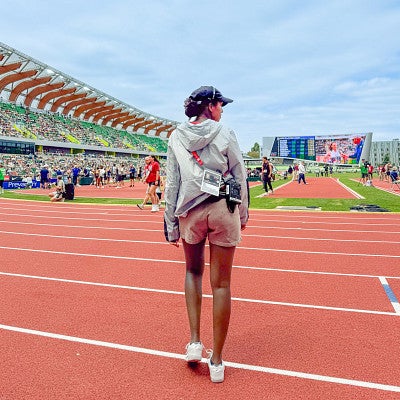
She also worked in sports media with Runner Space, handling archival uploads, live broadcast direction and highlight editing for track and field events. The experience offered a real-time education in how sports storytelling is constructed behind the scenes.
That awareness has reshaped how she sees media overall, especially in sports, where narrative framing can determine visibility. It’s also influenced her broader understanding of public relations and advertising as tools for storytelling, strategy and cultural perception.
While balancing her academic and professional work, Mazur completed the Eugene Half-Marathon for the fourth time in April and contributed as a strategist on the Gemini project for the Young Ones Student Awards 2026 with Google. The project was led by Cing Dim ’26, alongside Jasson Sission, Amarion Akinsanya ’26 and Joey Matsuno ’25 (producers), as well as their mentor, Eberhart-Garah.
“I felt like I was more of an overseer,” Mazur said. “I just made sure that things were making sense, publicity-wise.”
Looking ahead, Mazur’s work continues to orbit the same question that threads through her terminal project, classroom work and professional experience: how stories shape identity, and how strategy can decide which stories get told.
Lily Reese is a third-year journalism major at the SOJC, with a minor in food studies. She is passionate about storytelling, sustainability and lifelong learning. Lily loves to write, and you can find her work in Ethos magazine, Align magazine and Ascend magazine.