
From studying abroad and attending conferences to buying gear, donor-supported funds help SOJC students turn opportunities into real-world experience.

By Leo Heffron, Class of ’26
Learning at the UO School of Journalism and Communication (SOJC) isn’t confined to a classroom. It happens everywhere, from study abroad programs around the globe to conferences in diverse places, networking trips in big cities and informational interviews throughout the Pacific Northwest.
Often, these experiences come with a pricetag. Fortunately for SOJC students, financial assistance is available from the Experiential Learning Fund and new microgrants.
In 2018, donors Colleen and Joel McCloud ’67 created two of the first experiential learning funds, allowing SOJC students of all majors to get financial assistance supporting hands-on learning opportunities, professional development and networking, and access to diverse voices. Since then, over 15 new experiential learning funds have been established for different groups of students and even faculty.
New this year is a microgrant for students requesting less than $500. This smaller pot of money can support something as simple as covering gas for a trip to the coast for an interview or for purchasing a new mic for a podcast.
Jessika Kaiser, the senior associate director for donor relations at the SOJC, who manages 100 separate foundation funds, says many of the funds are aimed at helping students access diverse learning opportunities out in the world.
“Experiential learning has been something that donors really support, because they realize that for students to stand out, they need to be doing things outside of the classroom,” Kaiser said.
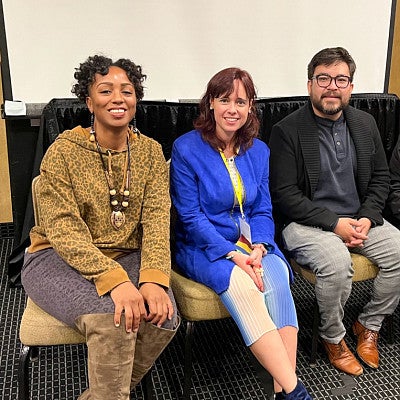
Experiential learning funds cover a wide range of opportunities
Both undergraduate and graduate students are eligible for the funding. Unlike scholarships, which are usually based on merit or need and primarily assist with tuition, experiential learning funds and microgrants cover costs such as travel, projects and professional development expenses. All SOJC students can apply, and, depending on the funding type and amount needed, they can get help paying for both large-scale opportunities like a term abroad in Spain or immediate needs like covering travel to an interview in Portland.
One recent recipient is Emilie Pons, an SOJC doctoral candidate in the Communication and Media Studies Ph.D. program, who received funding from the SOJC’s Harry Glickman Student Support Fund and the SOJC's The Everette E. Dennis & Emily T. Smith Student Travel & Research Fund to help cover the costs of her research. She is writing her dissertation on Middle Eastern and North African female vocalists and nationalism.
The funding has allowed Pons to travel to Washington, D.C., and Denver for conferences and pay for research activities and interviews.
Using these funds, she has also attended the American Society for Aesthetics Conference in Baltimore, and the microgrants helped her with expenses related to presenting her work, inviting and hosting other scholars and panelists, and attending events.
“It's so helpful,” Pons said. “It helps me just focus on the writing aspect of the dissertation and research.”
Another example is Adrian Garcia Dena, president of Unidos, UO’s chapter of the Hispanic Public Relations Student Association. He took over Unidos in the fall of 2024, with the goal of helping the club's members get professional development experiences.
Recently, 13 Unidos members traveled to Portland to visit public relations firms, such as Columbia Sportswear, Travel Portland, Gard Communications and Play Nice PR. Experiential learning funds helped cover transportation, food and accommodations for participants.
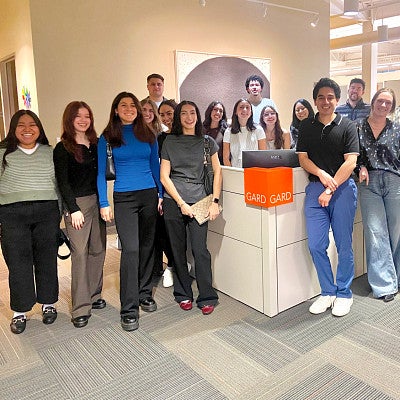
“These trips matter to students like us,” Dena said. “They let people figure out what they want to do in their lives.”
Plus, the trip helped build community, Dena said. “The whole group had a blast. Many of them told me that was the time of their lives.”
Experiential learning funds also pay for study abroad, speakers
After the trip, Unidos got additional funding to create a partnership with IZO, a Latino-run public relations agency in Portland. The goal was to create a public relations internship that would give underrepresented students opportunities to gain professional experience. Dena and his vice president pitched the idea directly to the agency with help from Kaiser and Atilla Schillinger, public relations director and professor of practice, emphasizing the importance of building skills and opening doors for students who may not otherwise have access.
Experiential learning funds aren’t limited to clubs, though. Students can also request support for study abroad and other unique trips, such as World Press Freedom Day in Brussels or the SOJC’s Media in Ghana internship trip, which takes place every summer.
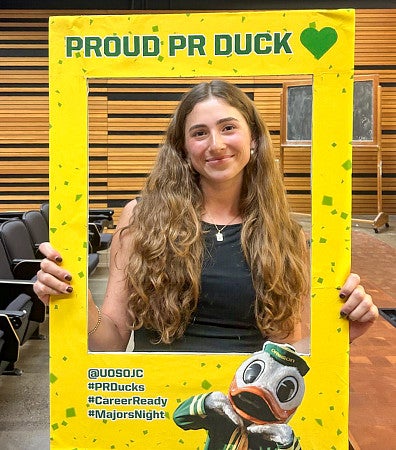
Even faculty can tap the funds to bring in speakers. For the 2025 SOJC Majors Night, faculty used the funds to invite Elizabeth Weltzien ’25, account coordinator at Segal Communications, to sit on a panel. Weltzien also spoke to public relations classes during her visit.
Applying for funding is designed to be simple
When applying for funds, students should be well organized and specific about their needs, Kaiser said.
“The more information about you that you can give, the better,” Kaiser said. “The more we can see into why you are requesting this money, the more likely you are to have success in the application. Showing how this experience will be an important benefit to your SOJC major and future professional goals is also key.”
Kaiser said that while the funding doesn’t necessarily cover all costs, it does help significantly. “The goal is to be part of the funding solution for students, not the entire support.”
Dena said applying was straightforward.
“Most of us just had to fill out a microgrant application and say how much money we needed for things like travel and food,” Dena said.
Two types of funds are available
Experiential learning funds and microgrants are both designed to help students prepare for the professional world and augment their course experiences.
The microgrant application is open on a rolling basis throughout the term. Applicants who are organized and clearly describe their projects and expenses will get a quick response, Kaiser said.
Experiential learning funds are for needs over $500. Students should plan to apply at least one term in advance, and applications are open the Friday of Week 1 through the Wednesday of Week 3 of each term. For example, if you are planning a project for the spring, you should apply during winter term. Your application should include a detailed description of your opportunity and a clear budget.
The funds give students real chances to explore what they care about outside the classroom. And as donor-supported funding continues to expand, SOJC students will get opportunities that shape their futures — not just fill out their résumés.
Learn More About Experiential Learning Support
Leo Heffron is a fourth-year journalism major at the SOJC, with a minor in Spanish. He enjoys writing about various topics, but fashion and social issues are his favorites. Leo is the associate opinion editor for The Daily Emerald and a staff writer for FLUX magazine.