
As protests grow more volatile, SOJC students and faculty grapple with the risks of reporting in the field.
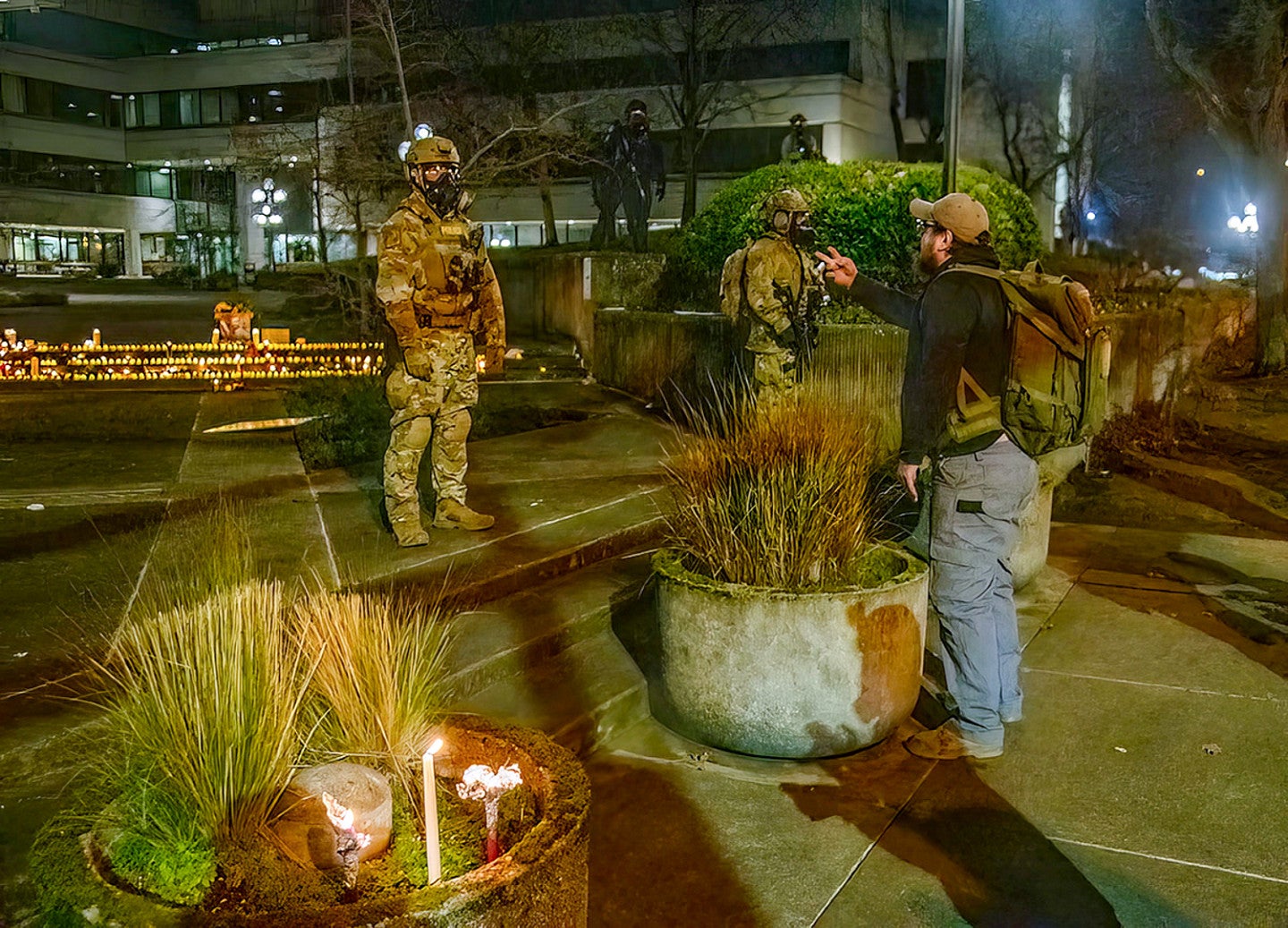
by Julia Boboc, Class of ’26
The sometimes-good, sometimes-bad thing about working at an NPR radio station is that the news is always on. It’s piped into the newsroom, the breakroom, the lobby.
So, a week into the new year, NPR was on at Eugene station KLCC, where I work, when an ICE agent killed Renée Nicole Good. For nine hours, I listened to breaking news and press conferences with Minnesota Gov. Tim Walz and Mayor Jacob Frey.
A little over two weeks later, NPR was on again when two ICE agents killed Alex Pretti.
As a journalist — and as a human being — it was hard to think about anything else.
In the weeks that followed, it became clear that something in our country had shifted. Participating in — and reporting on — protests now carried a weight of danger, of life-or-death risk, that I hadn’t seen in my lifetime. That danger would become a topic of conversation and debate in schools, homes and newsrooms across the country – including right here in Eugene.
On Jan. 25, Eugene community members gathered at the federal building to react to the killings of Good and Pretti, and my editor asked me to report on the protest.
I had covered multiple protests in Eugene, all without a hitch, and this one was no different. I stayed for a while, listening to people sing, chant and talk to each other.
Two days later, protestors and federal officers would clash in that same spot where demonstrators had recently been singing. Tear gas and pepper spray filled the air while I sat in class, unaware.
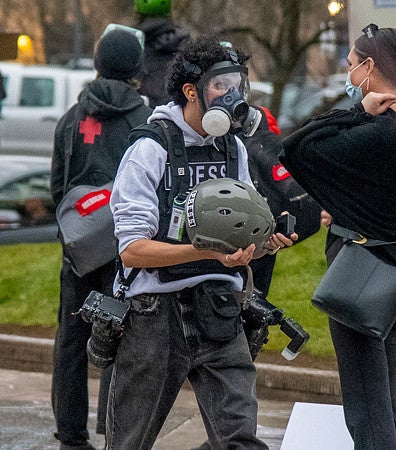
Back in the office for a news meeting, my editor, Chris Lehman, was visibly stressed.
At the meeting, reporter Zac Ziegler offered safety tips from his experience covering protests in Arizona: “Don’t wear your press badge on your neck.” Of course, I thought to myself. Someone might try to take it off.
“Someone could come up from behind and choke you with it,” he said.
The point hit me like a truck. It hadn’t occurred to me that people would intentionally try to hurt journalists.
Reporters’ safety was most important, Lehman said. “Your life is not worth it,” he added, looking at me. “If you feel unsafe, get out of there. Trust your gut.”
We don’t ordinarily talk about what is expected of journalists in the field. It can often feel like we’re required to put our lives on the line because we provide a critical community service. We’re supposed to run toward the spark so we can tell people about the fire. Getting burned is just part of the job.
So, while the conversation was frightening, it was reassuring to have an editor who didn’t want me to get hurt for the sake of coverage. And I was glad to be having the conversation at all.
Little did I know that the faculty at the UO School of Journalism and Communication (SOJC) were having similar discussions in Allen Hall.
After several meetings, they sent an email to students saying, “We strongly discourage you from covering these protests as student journalists without proper safety training and guidance.”
I was glad to know the SOJC faculty was addressing the issue. But at the same time, the conversations leading up to the email had happened out of earshot of students.
Maybe it was my journalistic curiosity — or maybe I’m just a nosy person — but I wanted to hear those discussions. I wanted to know what a room full of journalism professors had to say, and I wanted to contribute too.
So I pitched a piece to find out how professors' experiences as professionals and mentors have informed their perspectives on students covering protests and the urgency of the moment we are reporting in. Their comments were insightful.
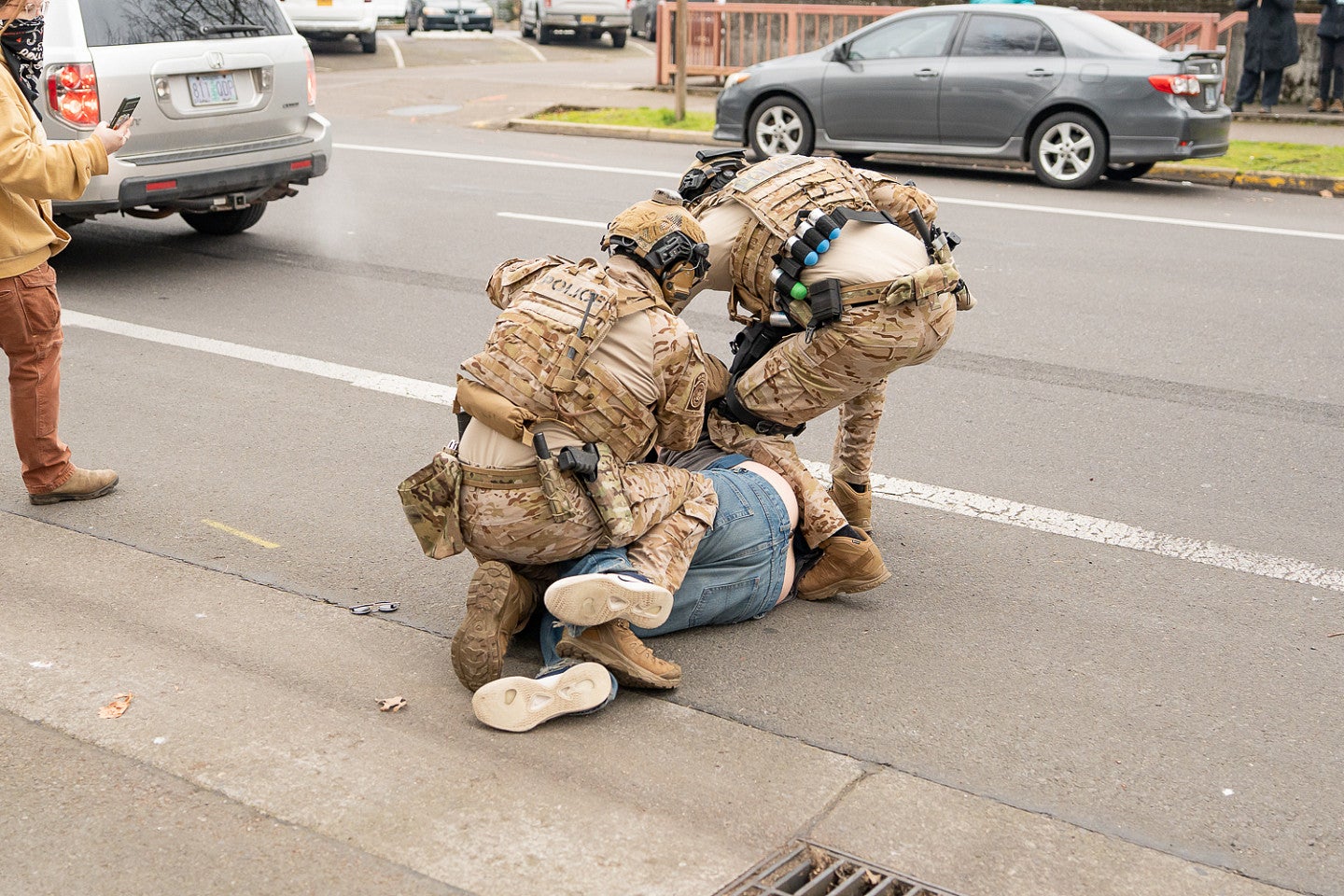
A discussion about student safety
On the last Friday of January, SOJC faculty met for their usual all-school meeting.
“It was a good turnout that day,” recalls Will Yurman, associate professor of journalism. “We don’t always get that.”
The meeting had a full agenda, but the elephant in the room couldn’t be ignored, recalled Dean Regina Lawrence. She said she started the meeting by pivoting away from the business on the agenda.
“We were going to talk about some things, but it seems like, given the timing of everything and what I’ve been hearing from you all, you want to talk about students covering protests — about what we should be doing to keep them safe,” she remembered saying. “Let’s start with where people are at. Tell me what’s on your mind.”
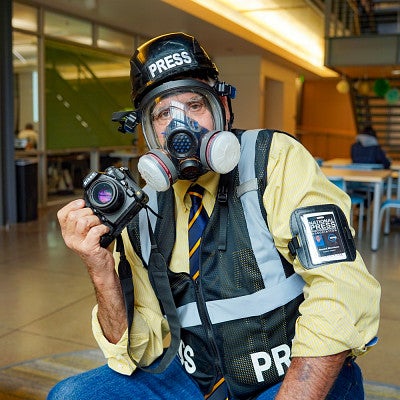
The first consensus was that protest coverage should never be a class assignment. That would be “horrendously unethical,” said photojournalist and Professor of Practice Dan Morrison. He should know. He’s covered protests around the world, and his work has taken him to the frontlines of war zones in Lebanon, Nicaragua, El Salvador, Afghanistan and other conflicts.
But it’s not always that simple. Sometimes students choose to cover protests for class projects. “Do I just tell them ‘no’ because we’ve all agreed as a faculty, no assigning protests?” Lawrence remembers a professor asking.
Many of the topics covered in the meeting — like discussions about attending protests with students, teaching protest coverage in class and conducting workshops on safety equipment and preparedness — were filled with disagreements and nuance.
The faculty made space for a variety of perspectives. I reached out to several professors who had voiced their viewpoints to find out how the discussion had played out and what they had to say about the situation. I also talked to students to hear how they approached protest coverage and if they shared the faculty’s concerts. Here’s what they told me.
When to discourage reporting experiences that might be dangerous
When it comes to assigning protest coverage, students like myself and Tarek Anthony, the editor-in-chief of the Daily Emerald, agree. “You didn’t register for Reporting I to be tear-gassed,” Anthony said.
But if a student asked Professor of Practice Lori Shontz to cover a protest for a class, she said she feels a responsibility to tell some of her students, “You’re not ready for this yet,” while guiding them toward other angles to tell the story beneath the protest.
But Assistant Teaching Professor Joey McMurry said he wouldn’t necessarily tell students “no.”
“We’re a journalism school. We should have students who want to go cover these sorts of things because they are important,” McMurry said. “We should respect that, and we should empower them as best we can while ensuring their safety.”
But empowering students while keeping them safe can be easier said than done. There is a thin line between empowerment and encouragement, and an even thinner line between being safe and being unsafe while attending a protest.
And, as Lawrence said, “These protests are not ‘average’ or ‘normal’ protests. We've got quasi-militarized federal agents with very powerful weaponry, and we've seen in other cities their willingness to use it.”
Morrison agreed.
“I hate to be another person throwing around the term ‘unprecedented,’ but this is unprecedented,” Morrison said.
And for journalists, a press badge is now more of a target than a shield, said Yurman, who also feels like this year’s ICE protests have been more dangerous than past demonstrations. “I’ve seen enough of it to feel like this is different, different in a way that felt scary (knowing) that our students were going there inexperienced.”
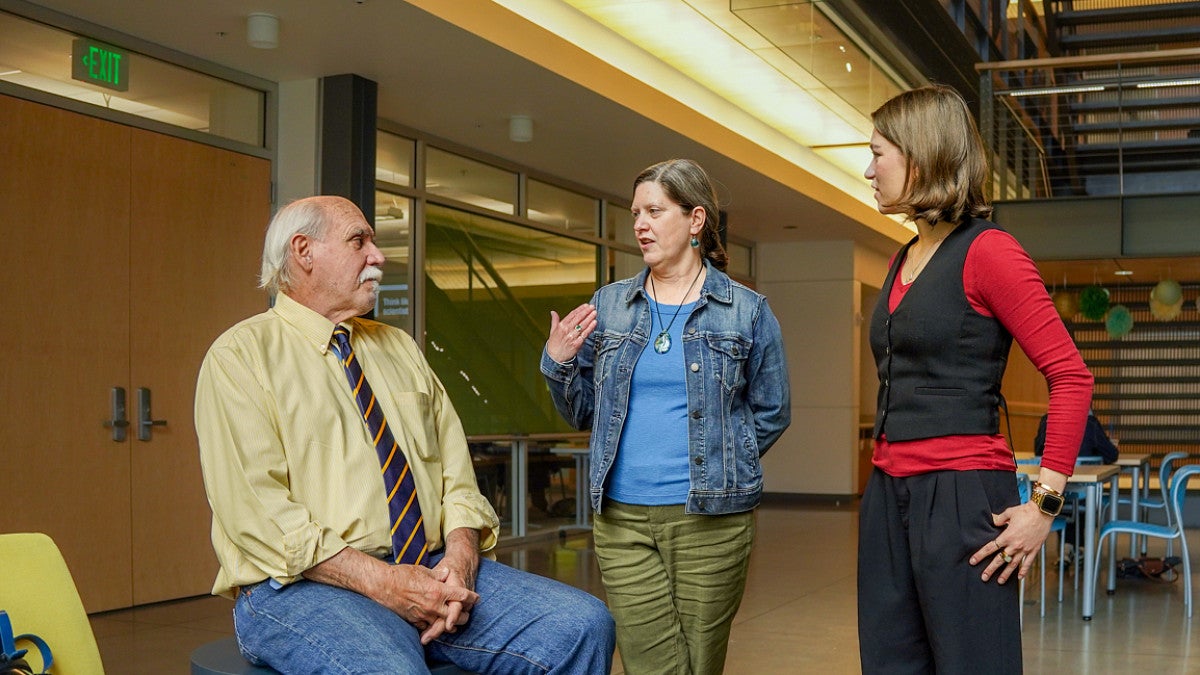
The Shontz-Morrison Debate Club
The SOJC faculty has its fair share of debates. Shontz said a lot of what was talked about in the school meeting had already been discussed in faculty offices and halls.
“We have these conversations all the time, but it's usually me standing at Will’s office door, or Dan bothering me,” Shontz said. “What was important about this was how Regina made space, so that we had a chance to make the conversation more formal.”
Those informal discussions, especially between Shontz and Morrison, sometimes end in disagreement – including on whether they’re disagreeing at all.
“One of the reasons I love her is because we argue so much,” Morrison said about Shontz, to the point where Morrison made Shontz a T-shirt with “The Shontz-Morrison Debate Club” printed on it.
I’m on two sides of this. Cover the protest, do it effectively, do it for real. And then, what else is there?
One such debate was about whether the protest is the most important part of the story.
Shontz said that, in the relentless news cycle, protest coverage can become reactionary and repetitive and lose sight of the issue at the heart of the event.
When safety is a concern, it can be valuable to approach the topic of the protest from a different angle.
“There’s behind-the-scenes stuff that’s happening, and speaking for people who cannot be there. We’re not hearing enough of those voices,” Shontz said. “I’m on two sides of this. Cover the protest, do it effectively, do it for real. And then, what else is there?”
Morrison agrees that journalists need to cover multiple angles of a story. But students shouldn’t be discouraged from covering protests because other angles are an option.
The impact on local communities and deep dives into the issue are really important, Morrison said. “But that’s not the only thing that’s really important.”
McMurry agreed.
People also need to know about the protests and the actions of agents in the cities they live in. That’s part of journalists’ roles, too, McMurry said.
“Part of our job is to document history, the first draft of history,” he said. “In order to have that draft, you have to be there.”
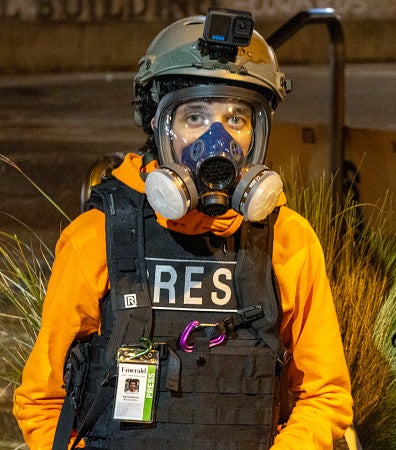
The veil of armor
As students, we’ve been trained to seek out the stories that matter and report on them with consideration and diligence.
SOJC students who are committed to journalism have stuck with it because we feel a sense of duty to pursue this work.
Anthony and other Daily Emerald journalists feel an obligation to cover the happenings of the city and campus.
“(Students) show up day after day because they feel the same responsibility as I do,” Anthony said. “If City Hall is on fire, we would be down there because we’re the newspaper.”
And it feels especially important to do this work now — in a moment of history — and also because we have so many resources at our disposal. The proximity of professors, alumni and classes puts us in the best position to learn how to be journalists as best we can.
While faculty acknowledge the duty and excitement students feel about covering protests, they also worry about the lack of experience that comes with being young and fresh.
“I see the value of it, and there’s an adrenaline rush. I see the excitement factor,” Yurman said. “I just don't want a parent to have to hear the news that something happened to their child.”
“I do think that sometimes 18- to 22-year-old armor is a real thing,” McMurry said. “You all think you are a little more invincible than you are. I was that way when I was 18 to 22. Getting you to recognize that the armor doesn’t cover your whole body is part of our job.”
Preparing through practice
That’s where preparation and equipment come in. A baseline understanding of what protests look like, what to look out for and what safe reporting entails could make a big difference once students are in the field.
“You have to have some kind of situational awareness, knowing what is in the area,” Shontz said. “One of the really important things about this is to go down and walk around the federal building before there’s a protest.”
Being prepared requires knowing the answers to a lot of questions and being able to implement them if the time comes.
Do you know what or who is behind you at all times? Do you have your medication with you in case you’re detained? What do you do when you get tear-gassed or hit with pepper spray? Do you know how to put on a gas mask in seconds? Could you get to your car or house blind?
“Do you know any of that?” Morrison asks. “No? Well, then, you should not be there.”
The complicated task is knowing how to give students that information without implicitly encouraging protest coverage or giving students a false sense of security. And, the truth is, it’s impossible to truly be prepared to cover a protest if you’ve never covered one before.
Part of our job is to document history, the first draft of history. In order to have that draft, you have to be there.
So how do you learn to cover protests safely with no experience?
McMurry and Shontz believe training will bridge the gap and they hope trauma-informed and conflict reporting curricula and trainings will be offered at the SOJC.
“I think we have to give people a chance to practice,” Shontz said, “but I think part of that is, here’s how you mentally prepare for this. Here's how you emotionally prepare for this.”
Anthony said training and resources are essential “because the students are going to go down there regardless.”
Plus, he said, if Morrison led a training telling students about his experience covering conflict and protests around the world, he would probably scare enough students away from going out themselves.
True, Morrison said. So he put that to the test.
He invited some interested students out to protests with him, first letting them survey the situation from the parking lot across the street from the federal building, then inching closer while offering tips along the way.
“Risk assessment is incredibly complex,” Morrison said. “But my main thing is, it’s not just it’s risky or it’s not risky. There’s a whole bunch of gradations between it’s really fatally risky, or it’s totally safe.”
Whether it’s going on a field trip with Morrison, looking at the resources offered by faculty or taking advantage of trainings and research on conflict and protest reporting, there are multiple options available for students to learn.
It’s impossible to prepare for or control every variable, but taking steps toward a better understanding of safety precautions and the changing landscape of protests can make a difference.
To get one step closer to preparedness, the SOJC will host two trainers from Aegis Safety Alliance on May 5, 7 and 8. The trainers will aim to visit classes as well.
This is “one effort the SOJC will be making to improve students’ sense of being more informed and safe when thinking about covering protests,” Lawrence said.
Julia Boboc ’26 is a fourth-year journalism major in the UO School of Journalism and Communication and a student in the Clark Honors College. She is a former intern turned reporting fellow with NPR’s affiliate station, KLCC. She is also the host and producer of the SOJC’s One Cool Story podcast. Learn more on her website.